Spring Time Means Filling Up With Invaluable Resources
Spring is Quietly Exploding
Spring and Nature is quietly exploding! In the north-western suburbs of Stockholm, just two days ago, buds were still just buds. Now, leaves are bursting into their fullness with a promise of a summer full of lush greenery, in sharp contrast to the bare branches of late autumn and winter.
For those of us with gardens and foragers, this is a busy time. As we don’t have enough space in our home to sow seeds indoors, that has to wait until temperatures have stabilised at 10°C or above.
Instead, it is time to harvest, which I know sounds strange… don’t you harvest in the autumn? Garden produce, yes. Nettles, definitely not.
Picking stinging nettles is a Spring thing. Equipped with a carrier of some sort filled with plastic bags, a secateur or a pair of scissors, gardening gloves and a great deal of excitement, I march off, preferably in the early morning to harvest.
The First Disappointment
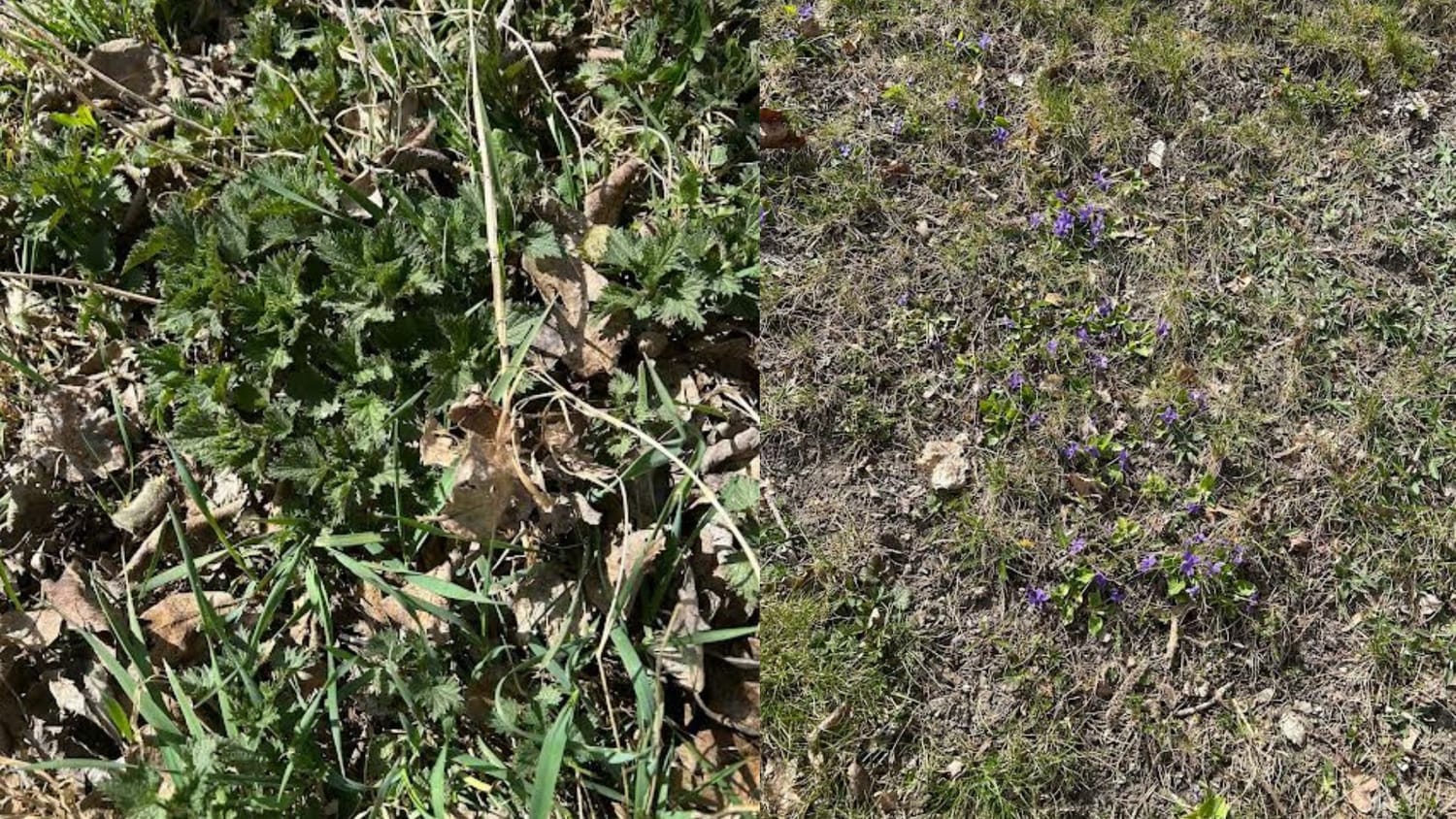
The first attempt here at home was a disappointment. The area where I usually pick nettles hardly showed any signs of nettles at all. It’s in a little birch-filled valley, away from the sun. It’s obviously much colder there than I was expecting, so on that day I went to other spots where I have found nettles earlier with the same disappointing sight… only tiny, almost microscopic pairs of leaves sticking up above the ground. You have to know they grow there to find them.
A couple days later, my husband and I went to have another look. On the way over the cow pasture we revelled in the fresh air, the sun and the beauty of the tiny white flowers in the cropped grass, the slopes filled with violets.
Allemansrätten — The Right of All People
Cow pasture? Do I own a farm? No, I live in Sweden where we have something called “Allemansrätten”: Alle (all) mans (people’s) rätt (rights). This means that all people in Sweden, no exceptions, are allowed to walk around in nature on anyone’s property (with the exclusion of the military, of course). You can pick berries, but not break branches or dig up protected species, camp out, but not start fires in places that can cause harm to
nature. You are expected to behave responsibly, leaving no trace of your visit, if possible. Unfortunately, there are those who just don’t care, but by and large, this is mostly respected.
So here, just 20 minutes from the centre of Stockholm there are fields and cow pastures and nettles grow there, and there aren’t many who pick this wonderful free natural resource.
The Birch and the Beer Can
We headed to our usual spot and the nettles hadn’t budged a millimetre since last time. Disappointed again, I decided to pick birch leaves from a tree with branches low enough, standing in the sunshine halfway up the hill. They also need to be picked really early. My husband held a branch down for me as I carefully picked a small batch. I don’t use a lot, just one little set of leaves in a cup of tea when I feel unwell. A giant birch I used
to speak with on a daily basis once told me it was medicine for me.
As I was tying a knot on that bag, I saw a beer can under some trees just a few steps away and went to pick it up. Can’t have that lying around, I thought. And when I approached it, there were nettles all over the place!
Perfectly developed! I offered gratitude for the guidance and we got to work immediately and picked away.
After about 30 minutes we felt we had enough – two full bags is a fair amount, and it has to be taken care of too. Before leaving, we revelled for a moment in the orgiastic nature of Nature as shown by the wealth of nettles and the magnificent fir tree they were growing under. All those flowers!
On the way back home we found a couple other patches and filled our bags up a little more, always thanking the plants, over and over, for the release of their treasure to me.
Back at Home
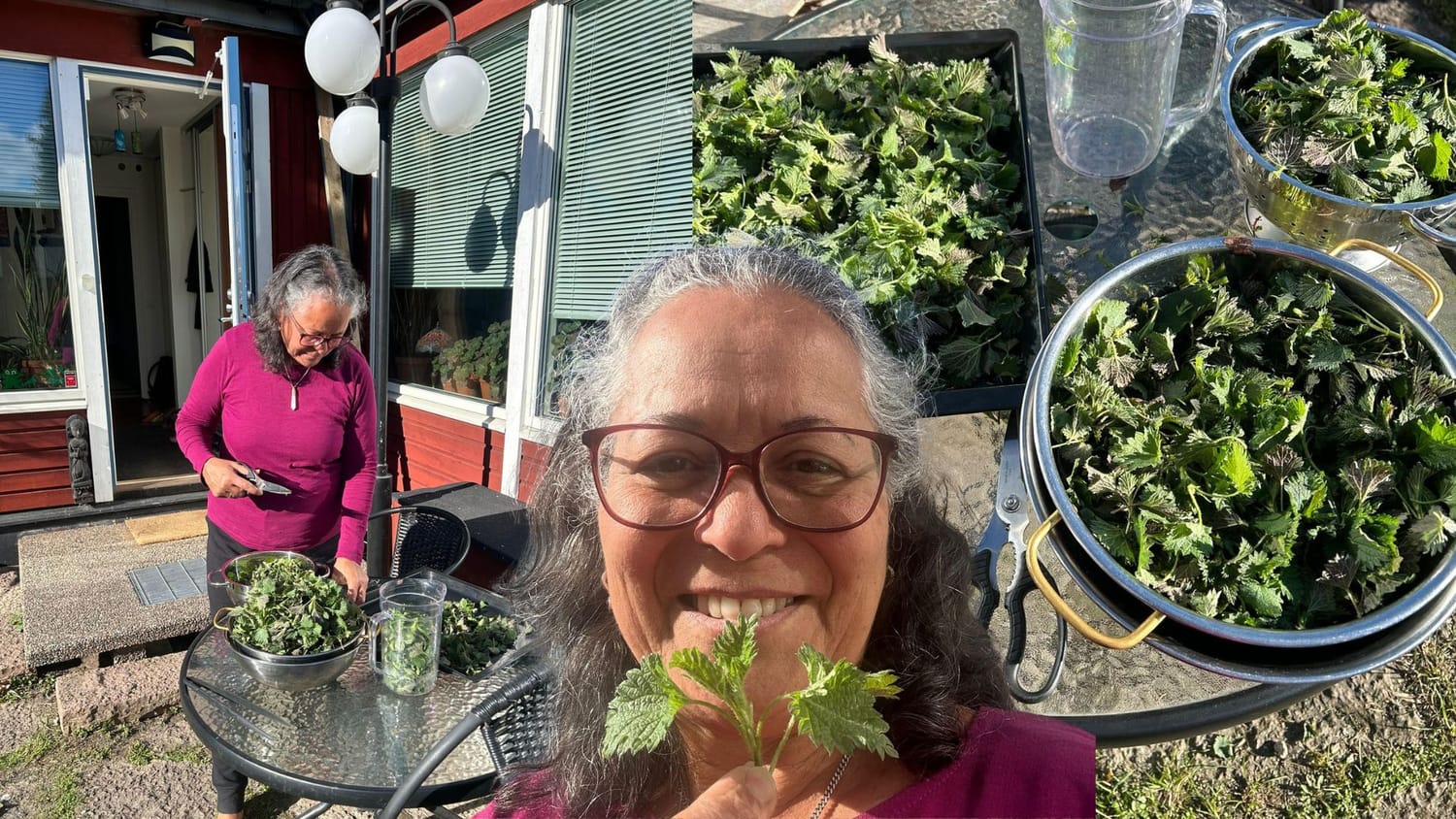
Back at home, there was the process of rinsing the nettles, and then cutting the stems from the leaves. When picking the nettles, I use gloves, when rinsing them I use kitchen tongs and when cutting the nettles, just my bare fingers. By then they are easier to grab hold of without getting stung.
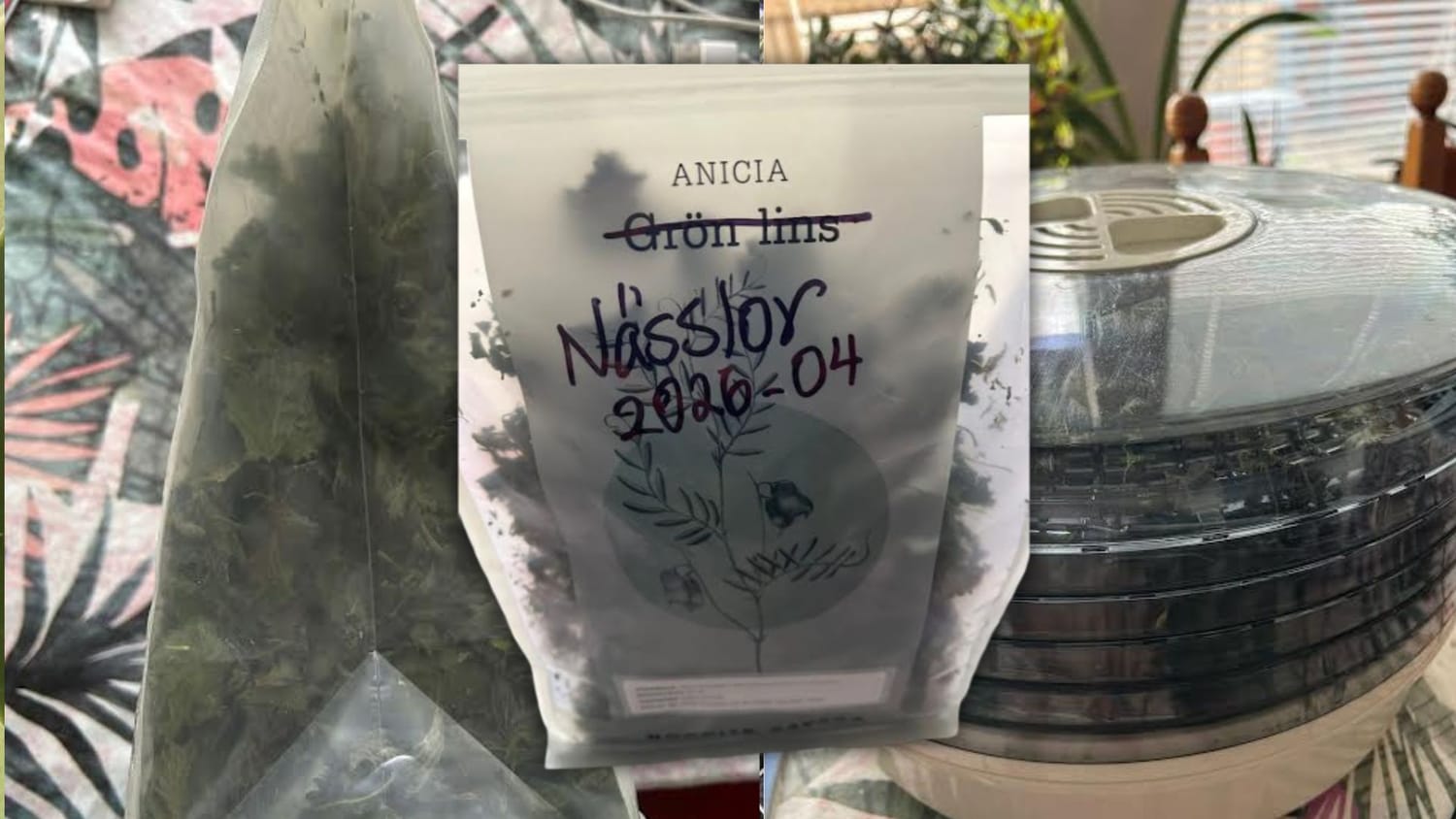
In the cutting process the nettles are sorted into two piles, one for making soup with and the other for drying, to be used later as either tea or powder (if I get enough). The reliable old 5-tier round food dehydrator (OBH Nordica) is brought out. Before going to bed that night, the leaves were all spread out in fairly fat layers and by morning they were all crispy dry allowing me to package them.
And of course, you can’t pick fresh nettles without making nettle soup! Delicious!
The nettle is an amazing plant. It loves growing in composting wood. Out at our cottage I find them growing in the old branches of wild roses. The ones I found here were happily growing among the composting cones of a big fir tree. Of course you can find nettles on farmland too, where they love to grow in manure or compost
piles.
What the Nettle Has to Teach
The nettle doesn’t stand out for her beauty, she has no bright blossoms and she doesn’t beg to be picked. Her sharp sting of protection makes itself felt for hours on end. You might find her nearby in disturbed ground, in compost, in the wild edges nobody tends, by most considered a weed to be eradicated. It is only when you approach her with care, gloves on, attention up, that she lets you take what she has to offer.
I think about this a lot. So much of what I work with, energy, healing, awakening, follows the same pattern. The good stuff isn’t sitting in a tidy display case waiting for a casual browser. It’s tucked away under the fir tree, beside the discarded beer can, hidden in the place you almost didn’t go. You have to be willing to be stung a little, to pay attention when she beckons to you and be ready to say thank you for the untold richness
she has to offer.
The nettle teaches reciprocity. I don’t strip a patch bare. I take what I need, leave plenty behind, knowing that she will send new shoots over and over again. Offering gratitude isn’t being sentimental, it’s acknowledging and appreciating the richness of our universe, it’s being in relationship with that richness. Just as the plants
know and the land knows, we too know and experience the glory of it all, somewhere underneath the hurry.
So when I bring those two bags home and set to work rinsing, sorting, drying, simmering, I’m not just preparing food but completing a small circle. And the soup at lunch, or the infusion in my evening cup, tastes of more than nettles.